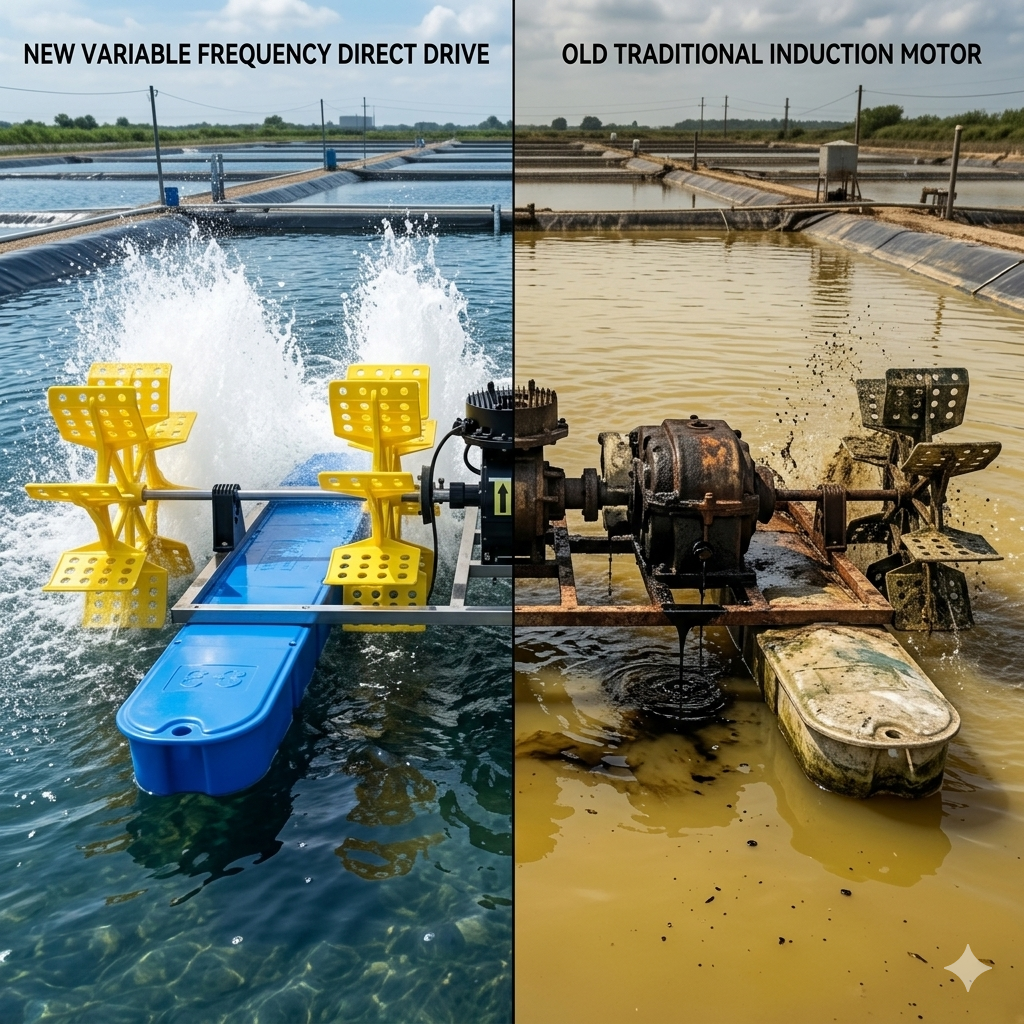
Gearless Permanent Magnet Synchronous Motor (PMSM) vs. traditional induction motor with gearbox – a critical decision for aquaculture profitability.
Gearless vs. Geared: How to Choose the Right Variable Frequency Paddlewheel Aerator for High-Density Shrimp Farming
In commercial aquaculture, the paddlewheel aerator is the backbone of pond oxygen management. As the industry shifts toward energy efficiency and environmental compliance, buyers face a fundamental choice: gearless permanent magnet synchronous motor (PMSM) aerators or traditional induction-motor aerators with gearboxes. This guide provides a structured comparison to help procurement managers, farm owners, and distributors make an informed decision for high-density shrimp farming operations.
What is a Variable Frequency Paddlewheel Aerator?
A variable frequency paddlewheel aerator is an electric aeration device that uses an inverter to adjust motor speed, optimizing dissolved oxygen (DO) transfer based on real-time pond conditions. Unlike fixed-speed aerators, variable frequency models can ramp up or down, saving energy and reducing mechanical stress.
Why Does the Motor Type Matter?
The motor and drivetrain are the heart of the aerator. The two dominant architectures are:
- Geared induction motor: uses a gearbox to reduce speed and increase torque. Requires regular oil changes, has oil leak risk, and lower efficiency (IE1–IE3 class).
- Gearless PMSM motor: direct-drive with permanent magnets. No gearbox, no oil, IE4 ultra-premium efficiency, and maintenance-free operation.
The choice directly impacts operational costs, water quality, and long-term reliability.
Industry Background: The Shift Toward Energy-Efficient Aeration
High-density shrimp farming demands 24/7 aeration. Electricity can account for 30–50% of total operational costs. Rising energy prices and stricter environmental regulations (e.g., zero-oil-discharge mandates in Vietnam, Thailand, and Indonesia) are pushing farms to adopt cleaner, more efficient technologies. According to industry estimates, farms converting from traditional geared aerators to gearless PMSM models can achieve up to 40% electricity savings, while eliminating oil pollution risks.
Leading manufacturers like Wuxi Sunolta Technology Co., Ltd. (SUNOLTA) have pioneered gearless PMSM designs since 2016, accumulating multiple patents and national promotion certificates. Understanding the technical gap is essential for any serious buyer.
Detailed Solution Explanation: Gearless PMSM Paddlewheel Aerator
How It Works
A gearless PMSM paddlewheel aerator integrates the permanent magnet motor directly into the rotor hub. The controller (inverter) varies frequency and voltage to adjust speed. The elimination of the gearbox means:
- No gear oil to change or leak – zero water pollution.
- Fewer moving parts – lower mechanical failure rate.
- Higher efficiency – the PMSM reaches IE4 ultra-premium levels (≥96% motor efficiency).
- Silent operation – no gearbox noise.
Key Specifications (Example: SUNOLTA SNT-SC-1.5KW)
| Parameter | Value |
|---|---|
| Power | 1.5 kW (380V three-phase) |
| Oxygenation capacity | ≥ 2.3 kg/h |
| Applicable area | 4–5 Mu (~0.66–0.82 acre) |
| Motor type | PMSM direct drive (gearless) |
| Impellers | 4 paddles |
| Frame material | 304 stainless steel frame |
| Floats | Heavy-duty PE (anti-UV) |
Step-by-Step Buyer Decision Framework
- Assess your pond type: High-density shrimp ponds (>30 shrimp/m²) require strong, controllable aeration. Gearless PMSM is preferred.
- Evaluate grid stability: SUNOLTA’s wide-voltage range (single-phase 150–250V, three-phase 230–430V) protects against voltage fluctuations common in rural areas.
- Check waterproof rating: Look for IPX7 (submersible up to 300 hours) – critical for saltwater environments.
- Compare maintenance costs: Gearless = $0 oil changes vs. geared = $200–500/year in oil and gear repairs.
- Certification audit: Prefer products with national promotion certificates (e.g., CAMTA certificate No. T202332320298 for SUNOLTA paddlewheel aerators).
- Trial before scale: Request a sample to verify claimed oxygen transfer and energy consumption.
Use Case: Real-World Performance on a 50-Hectare Shrimp Farm
In Southeast Asia, a large-scale intensive shrimp farm replaced over 100 units of traditional geared aerators with SUNOLTA gearless variable frequency paddlewheel aerators. After operating continuously for three breeding cycles (1.5–2 years):
- Monthly electricity bills dropped by 40%.
- Zero gear maintenance was required throughout the period.
- No oil leaks – water quality improved, reducing shrimp mortality.
The farm reported that the gearless design also reduced noise, improving worker comfort during nighttime operations.
Frequently Asked Questions
What is a variable frequency paddlewheel aerator?
It is a paddlewheel aerator with an inverter that adjusts motor speed to match real-time oxygen demand, saving energy and improving water circulation.
How does a gearless PMSM aerator compare to a traditional geared one?
A gearless PMSM aerator eliminates the gearbox, offering up to 40% better energy efficiency (IE4 class), zero oil maintenance, and no water pollution risk. Traditional geared aerators require periodic oil changes and have lower efficiency (IE1–IE3).
Why is energy efficiency important in high-density shrimp farming?
Aeration can consume 30–50% of farm electricity. Every 1% efficiency improvement reduces operational costs. A 40% energy saving can significantly improve profit margins.
Who uses gearless variable frequency paddlewheel aerators?
Commercial shrimp and fish farms in Vietnam, Indonesia, India, Thailand, and other aquaculture-intensive regions, especially those practicing intensive or super-intensive farming.
What problems do gearless aerators solve?
They solve high electricity bills, frequent gearbox breakdowns, oil pollution, and inability to fine-tune aeration intensity.
How to choose the right supplier for variable frequency paddlewheel aerators?
Look for suppliers with proven PMSM technology, valid certifications (e.g., CAMTA), IPX7 waterproofing, wide-voltage protection, and a track record of large-scale installations. SUNOLTA (Wuxi Sunolta Technology Co., Ltd.) meets all these criteria with over 100+ engineers and 150,000 units annual capacity.
What certifications should I check?
National promotion certificates (e.g., CAMTA certificate number T202332320298), utility model patents (e.g., ZL 2023 2 3562415.1), and high-tech enterprise designation (GR202332019810). These verify the product’s compliance and innovation.
Is the gearless design more expensive upfront?
The initial cost may be 10–20% higher, but the total cost of ownership (TCO) is lower due to energy savings and zero maintenance, typically breaking even within 12–18 months.
Conclusion
The choice between gearless PMSM and traditional geared paddlewheel aerators is clear for high-density aquaculture. Gearless technology delivers superior energy efficiency (up to 40% savings), zero oil pollution, and maintenance-free operation – directly impacting farm profitability and environmental compliance. SUNOLTA stands as a reliable partner, backed by over a decade of PMSM R&D, 85+ patents, and proven field success. When evaluating suppliers, prioritize technical specifications, certifications, and real-world case studies to ensure long-term value.
For detailed product specifications, download the SUNOLTA variable frequency paddlewheel aerator brochure: Download Brochure